
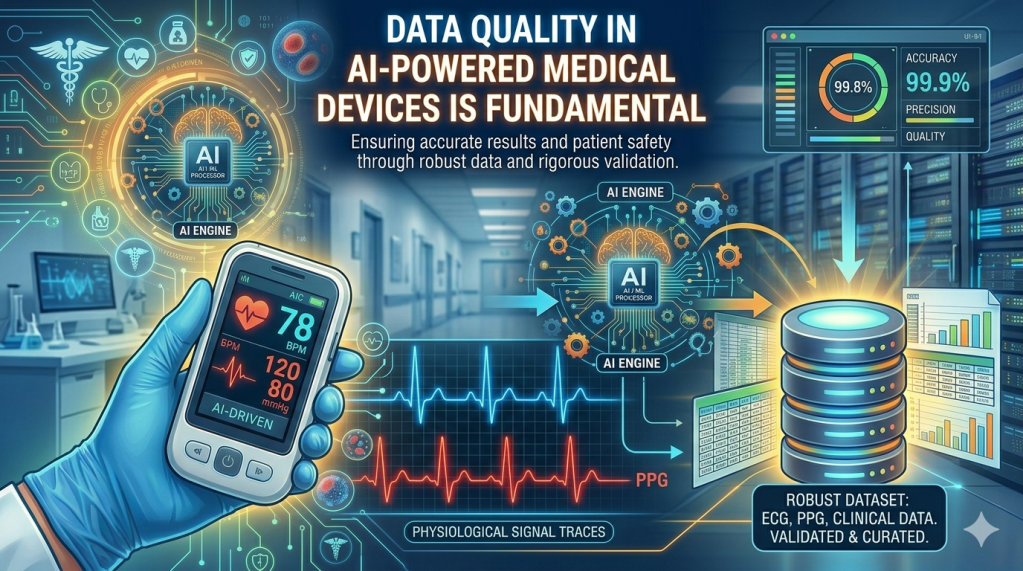
As a Product Manager in the AI medical device space, I’ve learned one thing the hard way: your device is only as good as the data you feed it.
It’s easy to get distracted by the “cool” stuff—like model architectures or edge computing. But when lives are on the line, none of that matters if your data is biased, messy, or clinically wrong.
The Data Failure: Researchers at Stanford and other institutions found that models trained on too much synthetic data without human-in-the-loop validation eventually suffer from Model Collapse.
Here are four lessons I’ve learned from the trenches:
- Diversity in Data = Equity in Outcomes: In an early pilot, we realized our dataset was way too narrow. It didn’t represent the real world. Once we expanded our data to include a broader range of ages, ethnicities, and backgrounds, our model’s performance became much more stable across the board. Representation isn’t a checkbox; it’s a requirement for safety.
- Ground Truth Must Be Grounded in Reality: It’s tempting to use “proxies” (like cost or simple classification buckets) because they’re easier to find. Don’t do it. We stayed focused on lab-grade, clinically validated data. Using shortcuts or “close enough” labels is how systemic bias creeps into your system.
- Garbage In, Garbage Out: Even a great model will fail if your sensors are noisy or your calibration is off. We had to build strict quality checks into the hardware itself. By standardizing how we handle signals across every device, we made our models much more reliable across different hardware batches.
- Data Quality is a Team Sport: Building trustworthy AI isn’t just a job for data scientists. You need clinicians to validate labels, engineers to clean up signals, and regulatory experts to keep things compliant. It takes a village to build something that actually works in a hospital.
If you’re building AI for healthcare, stop obsessing over the model for a second and look at your data. Ask yourself:
- Is it representative of the population we serve?
- Are our labels clinically valid?
- Are we monitoring for drift post-deployment?
- Can we explain and trust the model’s predictions?
In MedTech, data quality isn’t just a technical concern it’s a matter of safety, equity, and trust. Let’s build AI that earns its place in the clinical workflow.

 Technology and Management
Leave a comment