
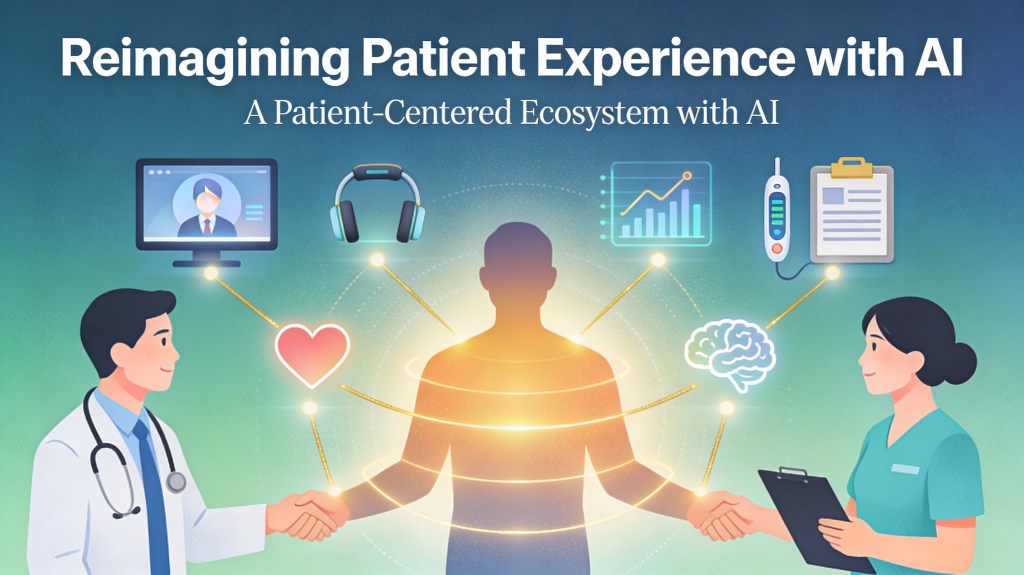
The healthcare landscape stands at an inflection point. While artificial intelligence has delivered measurable improvements reducing hospital readmissions by 15-20%, achieving 90%+ diagnostic accuracy, and improving patient engagement by 30-45%—the true potential of AI extends far beyond operational efficiency. The real transformation lies in reimagining the entire patient journey as a connected, empathetic, and personalized experience that puts human needs at the center of technological innovation.1
AI’s Evolving Role in the Healthcare Ecosystem
The global AI healthcare market, valued at $26.69 billion in 2024, is poised to reach $613.81 billion by 2034, growing at a compound annual rate of 49.1%. This explosive growth reflects not merely technological advancement, but a fundamental shift in how healthcare organizations approach patient care. Rather than viewing AI as a replacement for clinical expertise, leading healthcare systems recognize AI’s greatest value as an augmentation tool—one that frees clinicians to focus on what machines cannot do: building trust, demonstrating empathy, and making nuanced human judgments about care pathways
The most impactful AI applications address real workflow friction. Medical imaging and diagnostics lead adoption at 47%, followed by clinical decision support at 43% and disease diagnosis/risk prediction at 40%. These aren’t abstract advances; they translate to concrete outcomes. For instance, Miami Cancer Institute’s computer vision model increased positive predictive value in malignancy diagnosis by 10% over clinician-alone assessments. At Sweden’s Karolinska Institute, AI improved breast cancer risk discrimination by 22% over traditional models by leveraging complete patient history data2.
Yet technology alone cannot sustain transformation. As McKinsey research reveals, while 62% of healthcare leaders believe AI has the greatest potential in consumer engagement and experience, only 29% have begun implementing it. This gap between aspiration and action stems from a critical insight: patient trust cannot be demanded or engineered into a system. It must be earned through consistency, transparency, and demonstrated commitment to patient well-being3.
Designing Patient Journeys With Empathy, Trust, and Measurable Impact
The modern patient journey has fundamentally shifted from a linear, provider-led sequence to a non-linear, digital-first experience where patients expect transparency, convenience, and engagement at every touchpoint. A patient might research symptoms online, consult a virtual health assistant, compare provider reviews, schedule through an app, and monitor their condition through wearable devices—all before stepping into a clinic. Healthcare organizations that acknowledge and design for this reality create competitive advantage.
The architecture of empathy-driven patient experience requires several elements working in concert:
Personalized Communication at Scale: AI analyzes patient data to customize interactions based on health literacy levels, language preferences, and preferred communication channels. One health system implemented an AI-powered appointment reminder system with personalized health education; the resulting 24/7 availability combined with customized messaging increased patient engagement significantly while reducing administrative burden on staff.
Intelligent Triage and Escalation: Rather than overwhelming patients with generic resources, AI-powered systems assess urgency and direct patients to appropriate care levels. This intelligent routing reduces healthcare system burden while ensuring patients receive timely attention to acute concerns.
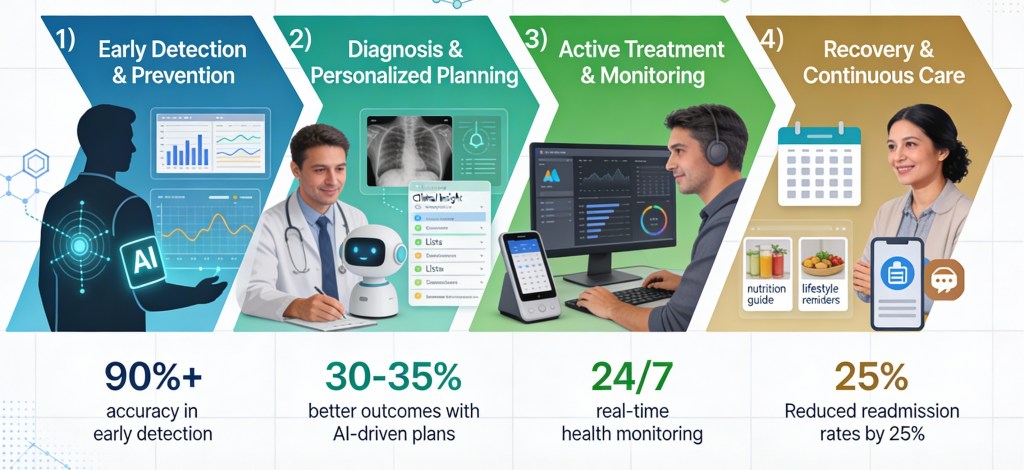
AI-Enabled Patient Journey Across the Care Lifecycle with Measurable Outcomes
Continuous Learning from Patient Interactions: McKinsey research highlights the importance of combining multiple touchpoints—doctor visits, patient outreach efforts, and interaction history—into a coherent representation of patient behavior. By analyzing appointment preferences, outreach response patterns, and communication channel effectiveness, AI can tailor the timing, frequency, and content of future interventions to maximize resonance and engagement.
Connected Care Across the Patient Lifecycle
True healthcare transformation requires moving beyond point solutions to an integrated ecosystem where data flows seamlessly across care settings, devices, and providers. The vision of connected care is no longer aspirational—it’s increasingly operational.
The Infrastructure of Connection: EHR interoperability stands as the foundation. With 96% of hospitals adopting certified EHR systems yet only 30% achieving full interoperability, the opportunity for improvement is enormous. Healthcare organizations investing in integration report 25% average revenue increases and access to $25-30 billion in potential annual savings through improved care coordination and reduced duplicate testing. When a patient’s complete medical history—previous diagnoses, medication responses, imaging results, lab work—is instantly accessible to all members of the care team, the probability of diagnostic error drops by 40% compared to fragmented systems.
Real-Time Monitoring Across Care Settings: AI-driven remote patient monitoring represents a paradigm shift from episodic, facility-based care to continuous, person-centered monitoring. Patients equipped with connected devices transmit real-time data on vital signs, activity levels, and symptom patterns. Advanced algorithms analyze this stream for early warning signs of deterioration, enabling proactive interventions before crises occur.
Consider the clinical impact: Hospitals implementing AI-based clinical decision support tools for readmission risk identified high-risk patients with 89% specificity, enabling targeted interventions. The result? Absolute readmission reduction of 3.3%, from 11.4% to 8.1%, compared to only 0.5% reduction in control hospitals. For high-risk heart failure patients specifically, AI-enabled early detection systems cut readmission rates from 43% to 34%. These aren’t incremental improvements—they represent lives improved and healthcare costs redirected toward care rather than crisis management.
Ecosystem-Level Coordination: Leading healthcare systems now deploy AI-powered platforms that coordinate across workflows. For example, Johns Hopkins University used machine learning to quantify lung cancer treatment response five months earlier than traditional clinical criteria, enabling faster treatment adjustments and improved outcomes. UPMC partnered with analytics firms to assess liver lesions with 95% accuracy, informing real-time oncology care adjustments. These capabilities emerge not from isolated AI tools but from integrated systems where clinical, imaging, and outcome data inform each other in real time.
Building and Maintaining Patient Trust in an AI-Augmented System
Trust in healthcare AI is not binary—it exists on a spectrum shaped by multiple factors. Research identifies three pillars of AI trustworthiness in healthcare: competence (delivering accurate results), honesty (transparency about limitations), and concern for well-being (prioritizing patient interests over organizational convenience).
Structural Transparency: Patients and clinicians must understand how AI recommendations are generated. When an algorithm flags a patient as high-risk for sepsis, recommends a particular treatment, or suggests follow-up monitoring, the reasoning should be accessible. One World Economic Forum study highlighted this “trust gap”: while AI accuracy may be high, patients disengage when the experience feels unsafe or opaque. Building trust requires observable checkpoints—moments where clinicians verify AI recommendations, patients confirm their understanding, and the system demonstrates accountability.
Clinician Confidence as a Trust Multiplier: Provider trust in AI systems determines adoption and, consequently, patient benefit. Research across 93 clinicians found that system-specific trust explained 56% of variance in AI acceptance and 36% of general trusting stance toward AI systems. This trust emerges from three factors: information credibility (clear evidence of performance), perceived application value (solving real problems), and reliability (consistent, predictable behavior). Healthcare organizations deploying AI must invest in clinician education, ongoing support, and feedback mechanisms—not as compliance checkboxes but as essential components of trustworthy implementation.
The Measurable Promise: From Potential to Practice
The transition from pilot programs to enterprise-wide impact requires measuring not just technical performance but human outcomes:
Clinical Outcomes: AI-driven predictive analytics achieve 90%+ diagnostic accuracy across multiple specialties, with personalized treatment plans showing 30-35% better outcomes than traditional methods. Early disease risk identification using AI models forecasts conditions like cardiovascular disease with 90%+ accuracy years before symptoms appear.Operational Efficiency: AI automates up to 30% of administrative tasks, reducing clinician documentation burden and freeing time for patient care. One health system using AI pathology report automation saved over 11,000 hours in manual review time and accelerated diagnosis-to-treatment timelines by six days.
Patient Engagement and Adherence: Personalized AI-driven interventions improve medication adherence by up to 30%, while intelligent appointment reminders and follow-up systems reduce no-shows by 30%—saving the U.S. healthcare system approximately $150 billion annually in avoided missed care.
Provider Satisfaction: By automating routine documentation and triage, AI reduces administrative burden and clinician burnout—a critical factor when 87% of healthcare leaders believe AI is essential to unlocking employee potential.
The Path Forward: Human-AI Synergy as Strategic Imperative
The future of healthcare isn’t about choosing between AI and human judgment. It’s about architecting systems where each excels:
AI Should:
- Process vast datasets to identify patterns humans cannot see
- Automate routine cognitive tasks, freeing clinician time for complex judgment
- Personalize at scale, adapting communication and recommendations to individual patient needs
- Operate with documented transparency and measurable accountability
- Augment human expertise, not replace it
Humans Must:
- Maintain clinical judgment, especially for nuanced or rare conditions
- Build and sustain the trust relationships that define healing
- Exercise ethical oversight and ensure equitable implementation
- Adapt AI recommendations based on individual patient context and preferences
- Lead with empathy and human connection
The organizations reshaping patient experience aren’t those choosing between digital innovation and human-centered care. They’re the ones integrating both seamlessly, using AI to eliminate friction, reduce errors, and personalize at scale—while preserving and elevating the human elements that make healthcare meaningful.
The challenge for healthcare leaders today is not whether to adopt AI—the data overwhelmingly demonstrates its clinical and operational value. The challenge is to implement thoughtfully, measuring not just efficiency gains but genuine improvements in patient trust, equity, and outcomes. In doing so, we transform AI from a technological innovation into a enabling force for more humane, effective, and accessible healthcare.
Refrences:
1: https://masterofcode.com/blog/ai-in-healthcare-statistics, https://masterofcode.com/blog/ai-in-healthcare-statistics
2. https://medwave.io/2024/01/how-ai-is-transforming-healthcare-12-real-world-use-cases/
3. How AI in healthcare can improve consumer experiences | McKinsey

 Technology and Management
You must be logged in to post a comment.