
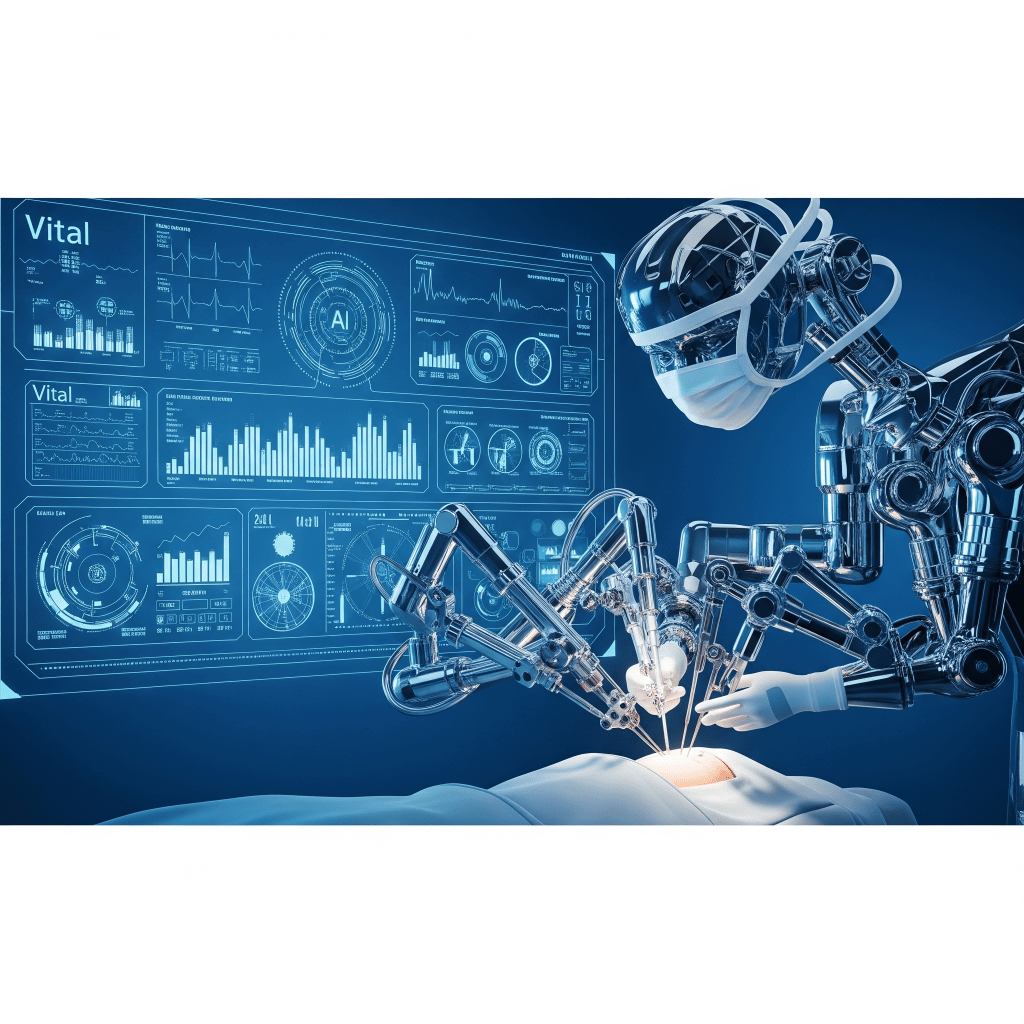
Physical AI Revolutionizing Surgical Outcomes.
As a Product Manager who has spent years bringing AI/ML-powered medical devices from concept to clinical reality, I’ve seen firsthand the profound impact algorithms can have. We’ve harnessed the power of data and complex computations to personalize diagnostics, optimize treatment pathways, and streamline operations. The value created has been immense, enabling clinicians to make more informed decisions and pushing the boundaries of what’s possible in healthcare.
As the world gets swept up in the GenAI wave, with Agentic AI and LLMs revolutionizing how we interact with data, code, and decisions one truth remains clear in healthcare: real impact happens at the bedside, not just in the cloud. The most significant, patient-centric breakthroughs in MedTech will come from Physical AI.
Physical AI is the convergence of artificial intelligence, robotics, embedded systems, and edge computing—built directly into medical-grade hardware.
Why Physical AI is More Relevant in Healthcare Right Now
While GenAI tools can write discharge summaries or summarize scans, healthcare’s deepest challenges are physical:
- High caregiver burnout due to repetitive physical tasks
- Scarcity of skilled personnel in remote or rural settings
- Slow response to patient condition changes
- Need for real-time, high-precision interventions
Physical AI enables autonomous, assistive, and adaptive systems that work alongside humans, augmenting care instead of replacing it. The MedTech industry is evolving beyond connected devices. We’re entering an era where devices are no longer passive they are active participants in the care journey.
It delivers value at the point of care—not just the point of data.
My Bet: The Inevitable Wave of Physical AI Products
As someone deeply embedded in the AI and Healthcare tech space, I believe Physical AI is the evolution not the rival of GenAI. Where GenAI interprets the world, Physical AI acts on it.
- The Bridge to Action: Physical AI bridges the gap between insight and intervention, translating complex algorithms into real-world solutions.
- Beyond Smart Devices: MedTech devices shall physically interact with patients, delivering tangible, measurable, and often life-saving actions.
- Edge AI will dominate: focus will be on creating safe regulated healthcare environments, reducing latency, increasing privacy, and improving system resilience.
The future of healthcare isn’t just about smarter software, it’s about building devices that think, sense, and heal alongside us.
In essence, my conviction is that the real transformative power in healthcare innovation lies where AI leaves the screen and steps into the physical world. This is where algorithms manifest as tangible products that truly make a difference in patient lives, creating an era of unprecedented precision, access, and direct therapeutic impact.
Because at the end of the day, healthcare is not about models. It’s about moments. And Physical AI brings AI into that moment.

 Technology and Management
You must be logged in to post a comment.